With the arrival of 2026, a change becomes not only desirable but necessary: a change in the way we cook and, more importantly, in the way we understand food. Not as a purely gastronomic experience, but as a system. As a daily practice with tangible environmental and social consequences.
Every item of food that ends up in the bin is not simply “leftovers”. It represents wasted time, wasted water, wasted energy, and wasted natural resources. It leaves behind a footprint that does not disappear when the bin lid is closed. Preventing food waste is no longer a matter of goodwill; it is an obligation. This obligation becomes particularly visible at the level of everyday life. Households account for the largest share of food loss, yet they also possess the greatest potential for meaningful change through simple, daily practices.
Within this context, initiatives that translate theory into action acquire particular significance. The LIFE IP Zero Waste Cyprus Project implements and supports such interventions, while simultaneously acting as a catalyst for strengthening and showcasing related actions carried out by other stakeholders through an active network of collaborations.
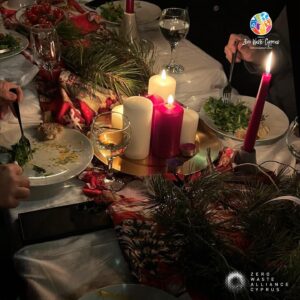
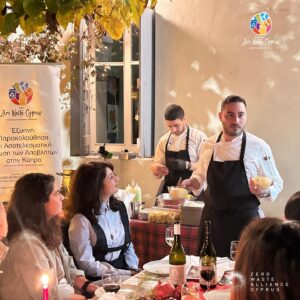
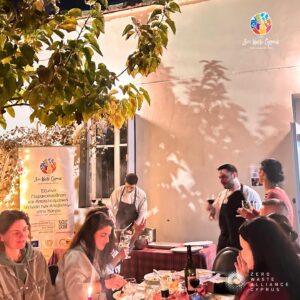
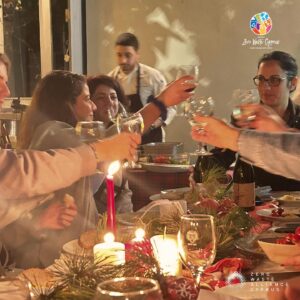
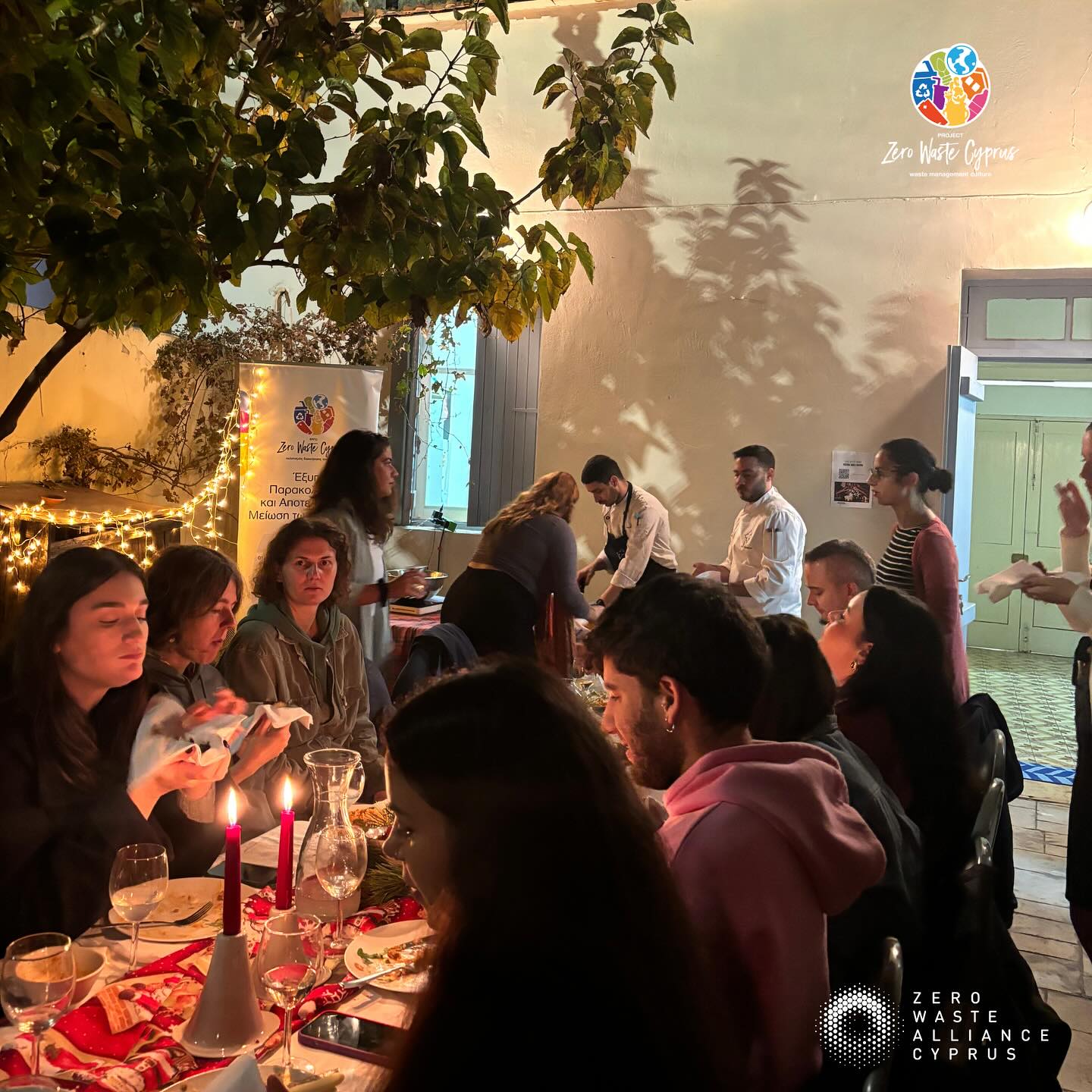
A characteristic example is the Zero Waste Dinner, which took place on 17 December 2025 in Limassol, within the framework of cooperation between the Project and the Zero Waste Alliance Cyprus. Twenty citizens participated in a hands-on experience that enabled them to understand, in practical terms, what a zero-waste dinner entails, how it is directly connected to sustainable cooking, and why it is a practice that can and must be integrated into everyday life.
A zero-waste dinner is not an isolated event but a way of thinking. It is the practical application of sustainable cooking through conscious planning, selection, and management of available food. Sustainable cooking does not begin with what we wish to cook, but with what already exists in our homes and with the mindful choices we make on a daily basis.
It involves creating meals using local and seasonal produce, food approaching its expiration date, leftovers from the previous day, as well as fruits and vegetables with natural imperfections. It also entails the full utilisation of raw materials, a preference for products with little or no packaging, and the avoidance of unnecessary purchases. Within this process, planning, creativity, and imagination function as essential tools for a kitchen that generates less waste.
This philosophy of sustainable cooking was clearly reflected in the evening’s menu, curated by executive Chef Jack Yiannakou, with the contribution of sous Chef Yiangou Ioannou. Rather than relying on “ideal” or specially selected ingredients, the menu made use of food items that commonly accumulate in households. Among them were bananas, highly nutritious fruit, that ripens quickly and is often discarded. These were transformed into a mousse, demonstrating how a “forgotten” ingredient can acquire new value. Similarly, kolokasi (taro), a local and seasonal product that is not always an obvious choice in everyday cooking and may often appear as surplus in local markets, was used to prepare a soup. In this way, the potential of local produce was highlighted, proving that sustainable cooking can be simple, nutritious, and flavourful at the same time.
An important element of the event was the “take what you need” corner, featuring surplus food and products close to their expiration date, offered by the local businesses Agno and Rescuedbox. This action underscored the fact that a significant portion of food waste is not linked to the quality or safety of products, but rather to our consumer habits and perceptions.
The dinner functioned not merely as a gastronomic gathering, but as a moment of awareness regarding the value of leftovers and the philosophy of “cooking with what we have, not with what we lack.” Participants exchanged experiences and reflections on the everyday behaviours that lead to food waste and discussed ways of change, while also being informed about the Project’s actions and objectives.
The substantive outcome of the event extended beyond the dinner itself. Practical guidelines for organising a zero waste dinner, as well as recipes demonstrating how new meals can be created using leftovers and local ingredients, are available digitally (*). The aim is to empower every citizen to incorporate the zero-waste philosophy into their daily life and to contribute meaningfully to the reduction of food waste.
By supporting initiatives of this nature, LIFE IP Zero Waste Cyprus strengthens the transition from awareness to action. Waste prevention does not require perfection; it requires consistency and conscious daily choices. And the kitchen is the first place where this change can and should begin. Because food is not merely something we consume; it is something we are obliged to respect.
We extend our sincere thanks to all those who participated in and supported the organisation of the dinner:
-
The Zero Waste Alliance Cyprus for the idea of dinner and its organisation,
-
Chef Jack Yiannakou and sous Chef Yiango Ioannou for the incredible recipes and dishes,
-
the local businesses Agno and Rescuedbox for supplying products for the food-sharing corner,
-
Gerolemou Estate for the provision of wines and
-
all those who took part and showed interest in experiencing this initiative.
* Digital material produced within the framework of the 2nd Zero Waste Dinner includes:
- Guide for organising a zero-waste dinner (page. 20): Project Dissemination-LIFE IP CYzero WASTE
- Recipes by Chef Jack Yiannakou, encouraging sustainable cooking using ingredients already available at home: Project Dissemination-LIFE IP CYzero WASTE
** Additional resources:
-
New Meals from Leftovers, developed through collaboration between LIFE IP Zero Waste Cyprus and the Cyprus Chefs Association: Project Dissemination-LIFE IP CYzero WASTE
-
Recipe booklet produced in collaboration with the Zero Waste Alliance Cyprus: Project Dissemination-LIFE IP CYzero WASTE
-
Best Practices Guide for Implementing Zero Waste Policies at Events and Festivals: Project Dissemination-LIFE IP CYzero WASTE